posted by ![[personal profile]](https://www.dreamwidth.org/img/silk/identity/user.png) is3 at 03:26pm on 22/04/2021
is3 at 03:26pm on 22/04/2021
is3 at 03:26pm on 22/04/2021Перевод фрагментов статьи кэмбриджского доктора археологии Кэйтлин Гирн "Средневековая "Новая Англия": забытая англосаксонская колония на северо-восточном побережье Черного моря"
Расположение средневековой Новой Англии и маршрут англосаксонских изгнанников:
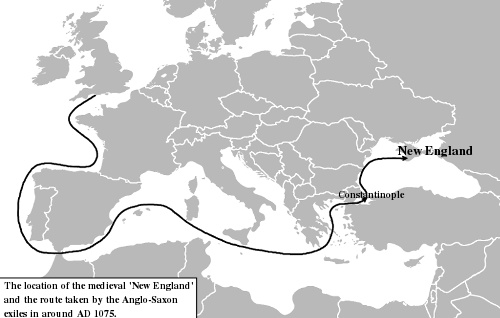
The location of the medieval 'New England' and the route taken by the Anglo-Saxon exiles
Excerpt from an article by the Cambridge Doctor of Archeology Caitlin Green "The medieval 'New England': a forgotten Anglo-Saxon colony on the north-eastern Black Sea coast":
( Read more... )
Хотя название "Новая Англия" теперь прочно ассоциируется с восточным побережьем Америки, это не первое место, которое так называли. В средневековье существовала еще одна "Новая Англия", и она лежала далеко к востоку от Англии, а не к западу, в районе Крымского полуострова. Далее рассматриваются некоторые свидетельства, относящиеся к этой колонии, которая, как утверждается, была основана англосаксонскими изгнанниками после норманнского завоевания 1066 года и, кажется, сохранилась, по крайней мере, до тринадцатого века.
Ключевые упоминания об эмиграции из Англии в Византийскую империю после 1066 г. включают краткий отчет Госселина Кентерберийского, написанный в 1090-х годах; другой отчет написан англо-нормандским историком Ордериком Виталием (р. 1075) в первой половине двенадцатого века; более подробное повествование, включенное в латинскую "Chronicon universale anonymi Laudunensis", написанную английским монахом в Лаоне в начале тринадцатого века; и связанное с ним, но, вероятно, не являющееся прямым производным, повествование в Эдвардсаге, или "Исландской саге об Эдуарде Исповеднике" ("Saga Játvarðar konungs hins helga"), которая, как считается, была составлена в четырнадцатом веке, но опиралась на более ранний текст, который вполне возможно, возник в начале двенадцатого века и также является источником Chronicon Laudunensis. Хотя ряд второстепенных деталей, таких как имя вождя изгнанников и точный маршрут, по которому они прибыли в Константинополь, различаются, в частности, в двух последних рассказах, в целом все доступные источники рисуют дополненную и последовательную картину.
Расположение средневековой Новой Англии и маршрут англосаксонских изгнанников:
The location of the medieval 'New England' and the route taken by the Anglo-Saxon exiles
Excerpt from an article by the Cambridge Doctor of Archeology Caitlin Green "The medieval 'New England': a forgotten Anglo-Saxon colony on the north-eastern Black Sea coast":
Although the name 'New England' is now firmly associated with the east coast of America, this is not the first place to be called that. In the medieval period there was another Nova Anglia, 'New England', and it lay far to the east of England, rather than to the west, in the area of the Crimean peninsula. The following post examines some of the evidence relating to this colony, which was said to have been established by Anglo-Saxon exiles after the Norman conquest of 1066 and seems to have survived at least as late as the thirteenth century.
Key references to this post-1066 emigration from England to the Byzantine Empire include a brief account by Goscelin of Canterbury, written in the 1090s; another by the Anglo-Norman historian Ordericus Vitalis (b. 1075), written in the first half of the twelfth century; a more detailed narrative included in the Latin Chronicon universale anonymi Laudunensis, written by an English monk at Laon in the early thirteenth century; and a related, but probably not directly derivative, account in the Edwardsaga, or 'Icelandic Saga of Edward the Confessor' (Saga Játvarðar konungs hins helga), which is thought to have been composed in the fourteenth century but drew on an earlier text that may well have had its origins in the early twelfth century and be the source of the Chronicon Laudunensis too. Although a number of minor details—such as the name of the leader of the exiles and the exact route that they took to get to Constantinople—vary between the latter two accounts in particular, in general the available sources all paint a complementary and consistent picture.
( Read more... )
There are no comments on this entry. (Reply.)